
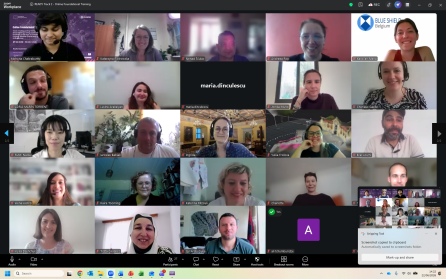
Twenty-five heritage professionals from 19 countries have joined READY – Safeguarding Cultural Heritage from Disasters, Extreme Weather Events and Complex Emergencies, expanding the growing European network of heritage risk managers and cultural first aiders.
Following the successful completion of READY Track 1, the online foundational training of READY Track 2 marks another important milestone in equipping heritage professionals with strengthened capacities to assess and mitigate risks, enhance emergency preparedness, and build resilience for heritage cities, sites, buildings, living traditions and associated communities in the face of disasters, extreme weather events and complex emergencies.
READY Track 2 is implemented through ICCROM's First Aid and Resilience for Cultural Heritage in Times of Crisis (FAR) programme delivery mechanism, with the support of the European Union's Creative Europe Programme. The course is further enriched by the expertise of 17 technical partners from across Europe and beyond, responding to the growing need for integrated, risk-informed approaches to safeguarding cultural heritage.
The new cohort of READY participants represents a broad range of disciplines, including heritage governance, architecture, archaeology, conservation, site management, civil protection, research, sustainability and climate risk. Bringing together multidisciplinary expertise creates a dynamic learning environment where participants learn from one another's experiences while developing a shared understanding of risk across sectors and disciplines.
Seeing cultural heritage as part of a living system
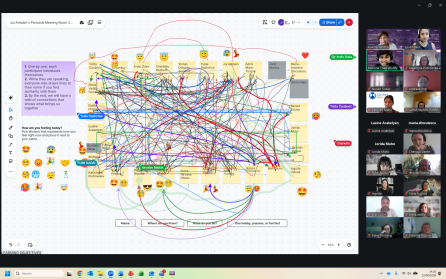
The online foundational training establishes the shared concepts, terminology, methods and practical tools that underpin ICCROM’s comprehensive disaster risk management methodology. Through interactive discussions, collaborative exercises, case studies, digital mapping, peer exchange and applied assignments, participants are encouraged to explore cultural heritage as more than isolated monuments and instead as part of interconnected territorial, environmental, social, cultural and governance systems.
Learning from one another and turning knowledge into action
READY Track 2 places practice and collaboration at the heart of the learning journey. From the outset, the cohort has worked in multidisciplinary and international teams, applying ICCROM's comprehensive disaster risk assessment methodology to shared case studies while progressively developing assessments for heritage places in their own countries. Using maps, visualization tools, landscape analysis, historical evidence, climate information, and stakeholder mapping, they are learning to understand how risks emerge through the interaction among hazards, exposure, vulnerabilities, capacities, and wider risk drivers.
The diversity of expertise is proving to be a powerful learning resource. Throughout the online sessions, participants shared experiences from recent floods, wildfires, conflict-affected areas and other evolving risk contexts, critically reflecting on how environmental, social, cultural and governance systems influence risk across territories. Through peer exchange and learning from one another, participants strengthened their technical capacities while building a growing community of heritage risk managers and cultural first aiders committed to more integrated, cross-sectoral and people-centred approaches to safeguarding cultural heritage.
The journey continues
As the online foundational training progresses, the knowledge and skills acquired throughout the course will be used to evaluate and prioritize risks, develop disaster scenarios, and design integrated strategies for disaster risk reduction, climate adaptation and emergency preparedness. Drawing on case studies from READY's technical partners across Europe – including Ukraine, Croatia and Portugal – and beyond, participants will explore practical approaches to managing complex and evolving risks to cultural heritage and strengthening resilience through anticipatory action, preparedness and coordinated planning before crises occur.
The online foundational training is only the first step in a year-long learning journey. Over the coming months, participants will conduct comprehensive disaster risk assessments of a selected cultural heritage place, site, building, or living heritage practice in their respective contexts, with support from the READY team. The learning journey will culminate in a two-week in-person training in Bucharest, Romania, from 7–18 September 2026, where participants will apply the principles of First Aid to Cultural Heritage through field exercises and simulations. They will work alongside Urban Search and Rescue (USAR) to practice damage and risk assessment, emergency documentation, salvage, stabilization, and coordinated first aid for cultural heritage in large-scale emergencies.