
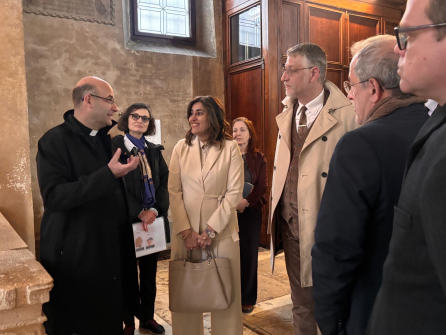
La directrice générale de l’ICCROM, Aruna Francesca Maria Gujral, accompagnée du ministre italien de la Culture, Alessandro Giuli, a effectué une visite conjointe de l’église des Érémitiques à Padoue, un site historique au cœur d’une redécouverte remarquable.
Cette visite faisait suite à la découverte de fragments de fresques appartenant à la chapelle Ovetari de l’église des Érémitiques. Ces fragments ont été identifiés dans les archives de l’ICCROM, apportant un nouvel éclairage sur une histoire poignante de survie et de restauration artistiques.
La découverte comprend trente et un fragments de peintures murales datant des XIVe et XVe siècles.
Parmi eux figurent de rares éléments rescapés de la chapelle Ovetari, peints par des maîtres tels qu’Andrea Mantegna, Nicolò Pizzolo, Antonio Vivarini et Giovanni d’Alemagna — une pierre angulaire de la Renaissance padouane du XVe siècle.
Cette redécouverte revêt une importance particulière au regard de l’histoire tragique du site. En 1944, pendant la Seconde Guerre mondiale, l’église a été gravement endommagée par les bombardements, réduisant ses célèbres fresques à des dizaines de milliers de fragments — l’une des pertes culturelles les plus dévastatrices subies par l’Italie pendant la guerre.
La visite conjointe de la Directrice générale et du ministre de la Culture a marqué une nouvelle étape importante dans le partenariat très solide entre l’ICCROM et le ministère italien de la Culture.
Il a été convenu de concevoir un projet commun, impliquant la communauté locale et les parties prenantes, afin d’explorer des possibilités concrètes de reconnecter ces fragments à leur cadre historique et spirituel d’origine grâce à des solutions innovantes. Ce projet commun vise à souligner leur valeur unique en tant que symbole puissant de survie et de résilience durable du patrimoine culturel, témoignant que la reconstruction peut conduire à une plus grande cohésion sociale et à une stabilisation, tout en renforçant un profond sentiment d’appartenance et d’identité.