
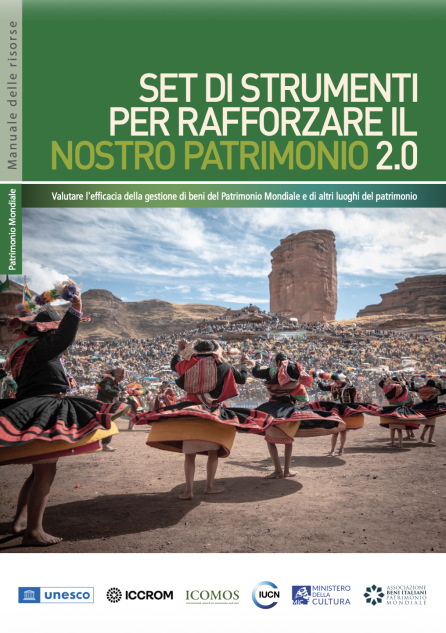
Rome, 21 May 2026 – A new Italian translation of the Enhancing Our Heritage Toolkit 2.0, developed by UNESCO, ICCROM, ICOMOS, and IUCN, is now available to support site managers and authorities in strengthening the management of World Heritage sites across Italy.
The release of the translation was announced by the Italian Association of World Heritage Properties, the Ministry of Culture, and ICCROM, making this internationally recognized methodology more accessible to Italian heritage practitioners. The manual provides a practical framework for evaluating the effectiveness of management systems for World Heritage sites and other heritage places.
The translation was carried out by the Italian Association of World Heritage Properties, with the support of the Ministry of Culture, in collaboration with ICCROM. By making the Toolkit available in Italian, the initiative strengthens the connection between national policies and international standards, while equipping site managers with a shared and up-to-date resource to address the increasingly complex challenges of heritage conservation.
Originally published by UNESCO and the Advisory Bodies of the World Heritage Committee – ICCROM, ICOMOS, and IUCN – the Enhancing our Heritage Toolkit 2.0 offers a globally tested self-assessment approach. It helps managers, institutions, and communities understand how effectively a site is being managed and to what extent its heritage values are sustained over time. Applicable to cultural, natural, and mixed sites, the manual supports improving decision-making processes, governance, planning, and resource allocation.
The Toolkit includes 12 operational tools that can be used together or independently to analyze all key elements of a management system – from defining values and conservation objectives to monitoring results and reviewing overall management effectiveness. Each tool is accompanied by practical guidance and guiding questions to facilitate its application in the field, particularly during the preparation, review, or updating of management plans.
"Making this tool available in Italian means strengthening the skills and capacities of heritage professionals and institutions in addressing contemporary conservation challenges through increasingly integrated, participatory and sustainable approaches. This publication fully reflects ICCROM's CARE vision – Conserving, Activating and Recognizing Cultural Heritage – which views heritage as a powerful driver of human well-being, shared responsibility and a more sustainable future," said ICCROM’s Director-General, Aruna Francesca Maria Gujral.
"The Directorate-General for European and International Affairs of the Ministry of Culture has been working for many years alongside those involved in the day-to-day management of World Heritage sites, providing the latest updates on the implementation of the relevant Convention and offering technical and scientific support to ensure that the sites’ activities are fully aligned with the Convention’s highest objectives. In this context, the Directorate General for European and International Affairs, within which Service II – UNESCO operates, has chosen to support, through funds allocated under Law 77/2006, the translation into Italian of the Toolkit 2.0 Manual, on monitoring the effectiveness of site management, and to ensure its publication in print, in the hope that this initiative will make a further concrete and effective contribution to the need to ensure the dissemination of information and the widest possible participation in best practices for the conservation of World Heritage,” stated Mariassunta Peci, Director General for European and International Affairs at the Ministry of Culture.
“The Italian translation of the Manual is fully in line with the spirit of the project Incontri e territori. Designazioni UNESCO a confronto, funded by Law 77/2006, which aims to raise awareness and disseminate, among Italian professionals involved in the management of World Heritage sites, the tools and opportunities made available by the UNESCO World Heritage Centre. For us, this is an important milestone: it puts a concrete tool in the hands of Italian site managers—one to be shared with stakeholders, local communities, administrators, and institutions—that can give heritage management the value it deserves,” said Carlo Francini, Scientific Coordinator of the Italian World Heritage Association, Director of the Florentine Civic Museums, and Site Manager of the Historic Center of Florence.
The Italian edition forms part of the broader commitment of ICCROM, the Italian Association of World Heritage Properties, and the Ministry of Culture to support integrated heritage management through practical tools, training, and international cooperation, in line with the World Heritage Convention and its Operational Guidelines.
Contacts
ICCROM: Camilla Ravetto, Communications Officer, communications@iccrom.org
Associazione Beni Italiani Patrimonio Mondiale: Daniele Piccinin, Addetto Stampa, daniele.piccinin@gmail.com
ICCROM is an intergovernmental organization dedicated to the conservation of cultural heritage. ICCROM aims at improving the quality of conservation practice as well as raising awareness about the importance of preserving cultural heritage. It serves the international community as represented by its Member States. ICCROM contributes to preserving cultural heritage in the world today and for the future through five main areas of activity: training, information, research, cooperation and advocacy.
The Directorate-General for European and International Affairs, within the Department for General Administration — under which UNESCO Service II operates — is responsible, among other duties, for overseeing the implementation of the most significant international conventions signed by Italy with UNESCO, including the Convention concerning the Protection of the World Cultural and Natural Heritage. Its main activities include coordinating nomination processes, providing technical and scientific support to site managers on management-related issues, monitoring the state of conservation of sites, and carrying out information and training activities.
The Associazione Beni Italiani Patrimonio Mondiale has been active since 1997, promoting, coordinating, and implementing initiatives and projects aimed at enhancing the value of Italy’s Cultural and Natural World Heritage, namely the Italian sites inscribed on UNESCO’s World Heritage List. Today, it brings together more than 50 institutions responsible for the management of Italian properties included on the World Heritage List. Italy holds the absolute record with 61 sites inscribed on UNESCO’s World Heritage List, including monuments, historic centres, archaeological parks, and natural landscapes — places recognized as unique and outstanding testimonies to the journey of humankind on Earth.