 Centre international d'études
pour la conservation et la
restauration des biens culturels
Publications
Heritage Place Lab: A Model for Research-Practice Collaboration in the Context of World Heritage
Heritage Place Lab (HPL), a new activity focused on strengthening networks across research and site management in the context of the implementation of the World Heritage Convention.
ICOMOS and ICCROM– Guidance on Post-Disaster and Post-Conflict Recovery and Reconstruction for Heritage Places of Cultural Significance and World Heritage Cultural Properties
It provides a framework for supporting and harnessing the recovery of heritage places to come to terms with and overcome the trauma associated with destruction and loss.
المَواثيقُ الدوليّةُ لِحفْظِ وتَرميمِ المَعَالِمِ والمَوَاقِع التَاريخِيَّة
تم إصدار هذا المورد كجزء من التعاون بين المجلس الدولي للمعالم والمواقع (إيكوموس) والمكتب الإقليمي لحفظ التراث الثقافي في المنطقة العربية (مركز إيكروم – الشارقة). وقد حظي هذا التعاون بدعم صاحب السمو الشيخ الدكتور سلطان بن محمد القاسمي، حاكم الشارقة وعضو المجلس الأعلى للاتحاد في دولة الإمارات العربية المتحدة، كما أنه يتوافق مع مهمة مركز إيكروم – الشارقة في مساعدة الدول الأعضاء في المنطقة العربية على حفظ التراث الثقافي لبلادهم.

National Conservation Policy in Asia
This volume is a collection of papers from the 2016 ICCROM-CHA Forum on National Conservation Policy. It was the fourth in a series of five forums from 2013–2017 and resulted from an ongoing collaborative effort between ICCROM and the Cultural Heritage Administration (CHA) of the Republic of Korea. This volume provides a glimpse into some of the region’s diverse national policies governing heritage conservation, from Pakistan to New Zealand. As Adeni Masni (this volume) states, “The heritage of Malaysia is an embodiment of the history, culture and values representing the Malaysian people”, and the national policies which govern its identification, protection, use and conservation demonstrate the importance of heritage to a national psyche.
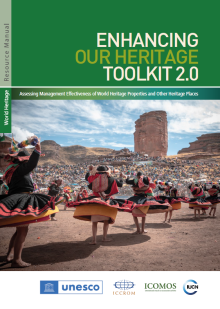
Enhancing Our Heritage Toolkit 2.0
It offers a World Heritage-specific methodology of management effectiveness assessment that can be applied to cultural, natural and mixed sites.
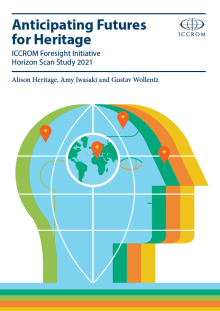
Anticipating Futures for Heritage
As part of its Foresight Initiative, ICCROM launched a horizon scan study to gather intelligence about possible macro-environmental changes that might affect cultural heritage in the future.
Glossary of Arabic Terms for the Conservation of Cultural Heritage
This glossary of cultural heritage conservation terminology, intended for conservation professionals working in the Arab region, is a preliminary document distributed to invite discussion and comments. It complements a glossary of technical terms published in ”Readings in the Conservation of Mosaics."
Available in Arabic-English and English-Arabic.
Available in Arabic-English and English-Arabic.

Restoration project at El-Dor Archaeological Temple (Emirate of Umm Al Quwain, United Arab Emirates)
This book is an example for balancing real-world challenges and heritage conservation constraints by international conventions. It is aimed at project managers, as well as restorers working in laboratories or sites who are interested in learning about some of the scientific techniques and analyses used in the project which can be applied in similar projects. As a highly specialized field of expertise, the implementation of this project gave great attention to that the cultural value of the temple to be enhanced, by preserving the authenticity of the monument, in order to highlight the message and meanings of the historic place through actions aimed at raising the awareness of society and its significance.
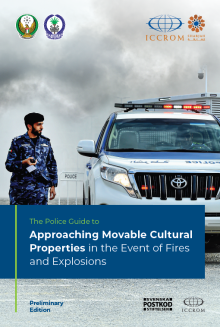
The Police Guide to Approaching Movable Cultural Properties in the Event of Fires and Explosions
This guide is intended to enable users to coordinate multi-sectoral first response and rescue initiatives, including damage and risk mitigation, and the prevention of looting, vandalism, and illicit trafficking of affected cultural property in case of an emergency, particularly in case of fire or explosion incidents. It is designed for use within the local context of Sharjah, and carries the potential for wider adoption at national level.