
Taking place-based and people-centred approaches to heritage
Organizers
ICCROM, IUCN, NRICH – National Research Institute of Cultural Heritage (Republic of Korea), KHS – Korea Heritage Service, and the Ministry of Climate and Environment of Norway, in collaboration with the National Institute for Maldivian Heritage Research (NIMHR) under the Ministry of Dhivehi Language, Culture & Heritage of the Republic of the Maldives.
Partners
- Korea Heritage Service of the Republic of Korea (KHS)
- The Academy of Dhivehi Language of the Republic of the Maldives (DBA)
- National Center for Cultural Heritage of the Republic of the Maldives (NCCH)
When
5–23 April 2026 (three weeks).
Where
Malé, Maldives, with activities hosted in relevant heritage places, museums, collections, and community settings in and around Malé and other selected locations
Why
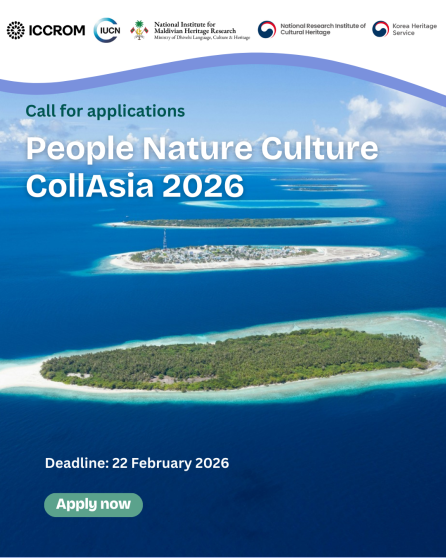
People–Nature–Culture (PNC) CollAsia 2026 will bridge heritage place management and collections care within a single, integrated framework. The course responds to the growing need for approaches that recognize the interconnections between tangible and intangible heritage, nature and culture, and movable and immovable heritage, and that place people and their rights at the centre of heritage practice.
Focusing on the linkages between collections, living practices and their wider heritage places, the course will support participants in strengthening governance, collaboration and decision-making for conservation and management. It will also help heritage professionals understand how collections and associated practices contribute to the multiple values of heritage places and to the well-being of Indigenous Peoples and local communities.
What
PNC CollAsia 2026 will provide a space for participants to explore tools and approaches that connect collections management with heritage place-based and people-centred methods. Building on lessons from previous CollAsia editions and the ICCROM–IUCN World Heritage Leadership course “Managing World Heritage: People–Nature–Culture”, it will combine foundational theory, scientific principles and diverse knowledge systems.
At the end of the course, participants will be able to:
- Explore the relationships between practices, collections and their heritage places, and understand how collections provide evidence of heritage values and community connections.
- Explore relationships among people, nature, and culture in the identification, management, and care of heritage places and associated collections.
- Understand and apply rights-based and people-centred approaches that recognize multiple heritage values and the roles of Indigenous Peoples and local communities (IPLCs).
- Strengthen the connection between collections management and the wider heritage place through a heritage place approach that considers social, environmental and economic contexts.
- Analyze the governance of heritage places to identify relevant actors, their responsibilities, roles and interests in relation to collections and places.
By integrating these dimensions, the course aims to enhance individual and institutional capacities to manage collections as integral parts of their heritage places and to contribute to sustainable development and local wellbeing
How
This three-week residential course will combine interactive lectures, case study discussions, hands-on workshops, site visits and group exercises in heritage places and collections in the Maldives. The content will be grounded in the World Heritage Resource Manual on Managing World Heritage and the Enhancing Our Heritage Toolkit 2.0, and delivered using the CollAsiapedagogical approach that emphasizes continuous professional development, observation-driven learning, critical thinking and applied research.
The programme will be delivered in English.
Who Should Apply?
The course will bring together approximately 25 participants, including around 15 participants from the Maldives and 10 international participants from ICCROM Member States in the Asia-Pacific region. Participants should be actively engaged in the care and management of collections and/or heritage places and interested in integrating people–nature–culture and rights-based approaches into their work.
Priority will be given to:
- Heritage and museum professionals, curators, conservators, restorers and community representatives working with collections associated with cultural or natural heritage places (e.g., protected areas, cultural landscapes, historic towns, archaeological sites).
- Professionals involved in heritage planning and policy, particularly those focusing on links between tangible–intangible and movable–immovable heritage.
- Educators, researchers and community practitioners working with collections and heritage who wish to strengthen place-based and people-centred approaches.
Applicants should have at least 3 years of relevant professional experience and be able to actively contribute to discussions and group work in English.
Course Fees and Scholarships
Selected participants will not be required to pay a course fee. Subject to the availability of funding, scholarships will cover round-trip travel, accommodation and meals in the Maldives for the duration of the course. Priority for scholarships will be given to candidates from ICCROM Member States in Asia and the Pacific, with particular consideration for those who can demonstratestrong institutional support and potential for follow-up action.
Entry visa for the Maldives is free of charge on arrival. All visa-related documentation and arrangements will be facilitated by the National Institute for Maldivian Heritage Research.
Participants or their institutions will be responsible for travel insurance, and any other personal expenses related to their participation.
To Apply
Interested candidates must complete the online course application form by 22 February 2026
Required application materials:
- Portrait photo (formats: jpg, jpeg, png, tif, tiff; max. 5 MB)
- Official endorsement letter (formats: pdf, doc, docx, jpg, jpeg, png, tif, tiff; max. 5 MB)
- Curriculum Vitae (formats: pdf, doc, docx; max. 5 MB)
- A personal statement (around 500 words) describing:
- How people–nature–culture and place-based, people-centred approaches are reflected in their current work with collections and/or heritage places.
- How participation in PNC CollAsia 2026 will help them strengthen links between collections, heritage places, local communities and sustainable development in their context. (formats: pdf, doc, docx; max. 5 MB)
For further information, please contact collasia2026@iccrom.org.