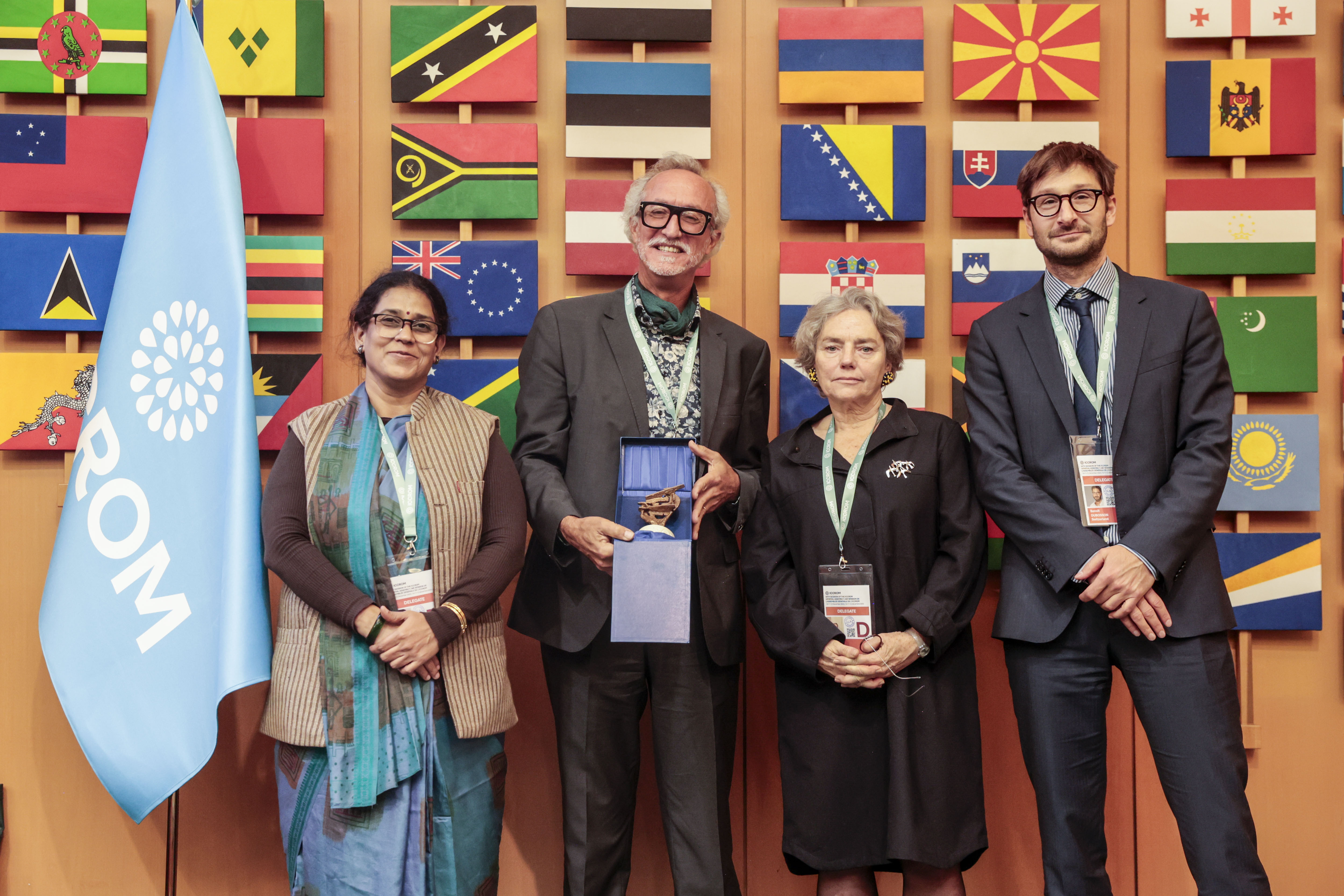
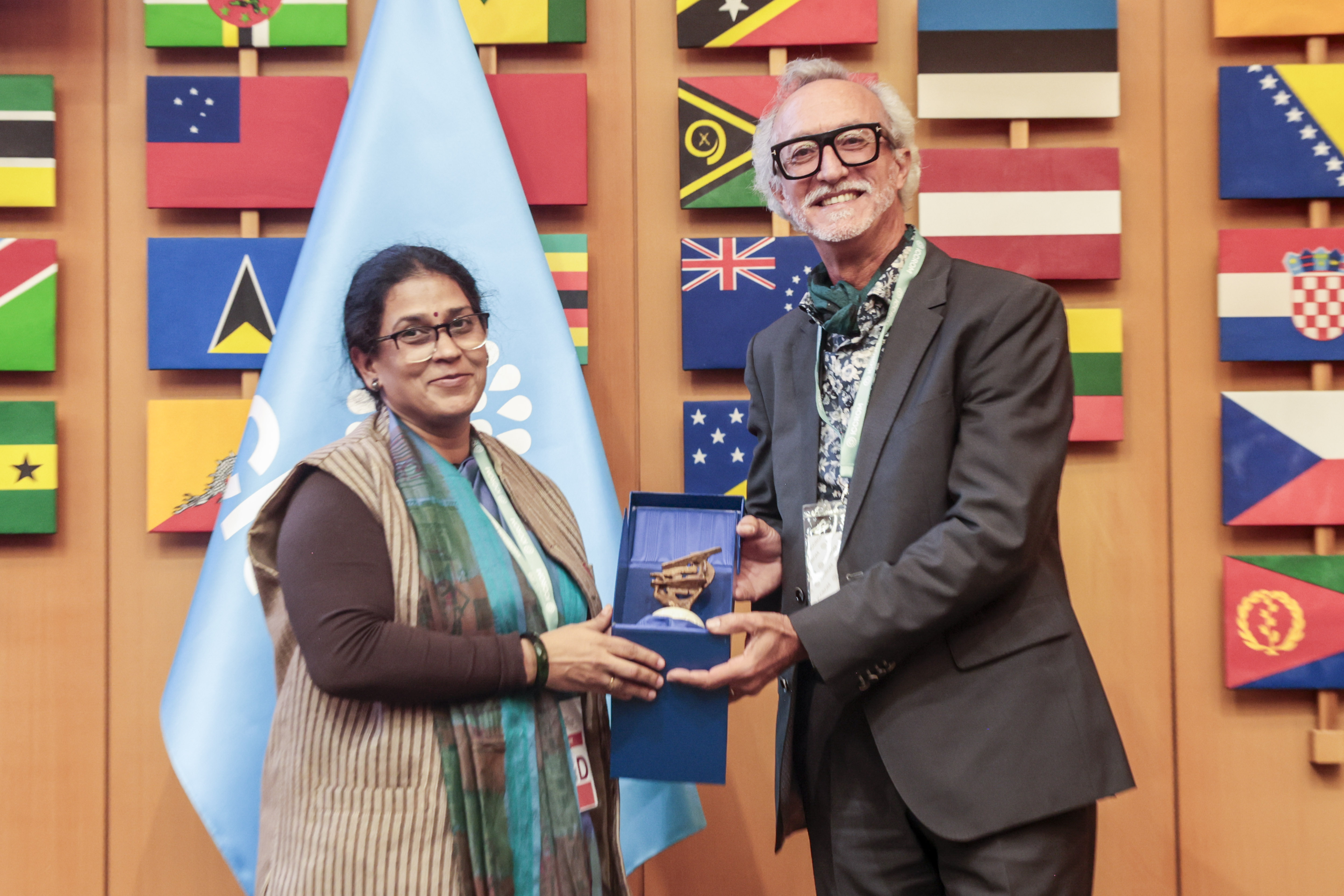
The 2025 ICCROM Award was presented at the 34th session of the ICCROM General Assembly, held on 10–12 December 2025 in Rome, Italy. This biennial Award is among the most prestigious international recognitions in the field of cultural heritage and is granted to individuals who have made outstanding contributions to ICCROM’s development or demonstrated exceptional merit in the conservation, protection, and restoration of cultural heritage.
The 2025 recipient, Dr. Khaldun Bshara, is a distinguished architect, anthropologist, restorer, and scholar who has played a leading role in shaping heritage conservation practice and discourse in Palestine for over three decades.
What distinguishes Dr. Bshara’s approach is his understanding of heritage as a living socio-political process. He champions what may be described as “anthro-driven restoration”—an approach that places community values, historical meanings, and Indigenous narratives at the heart of conservation. His work combines traditional techniques and local materials with cutting-edge technologies, offering a holistic model of restoration that bridges the technical and the poetic, the spatial and the social.
Dr. Bshara’s career is deeply rooted in his long-standing association with RIWAQ – Centre for Architectural Conservation, where he began as an architect and designer in 1994. Over the past thirty years, he has held several pivotal roles, including restoration architect, director of the conservation unit, and director/co-director from 2010 to 2020.
Today, he continues to serve as senior advisor and editor of RIWAQ’s influential Monograph Series on the Architectural History of Palestine. Under the visionary guidance of RIWAQ’s founder, Dr. Suad Amiry, and through Dr. Bshara’s leadership, the institution has restored numerous historic buildings and ensembles—particularly in marginalized rural areas—contributing significantly to the revitalization of towns, villages, and their cultural heritage.
Central to Dr. Bshara’s impact has been the training of hundreds of young architects, engineers, contractors, and craftspeople, especially through field-based learning programmes. His expertise and methodology were significantly shaped by his participation in ICCROM’s Stone Conservation course in Venice in 2003, which laid the groundwork for the drafting of RIWAQ’s Guidelines for the Maintenance and Restoration of Historic Buildings in Palestine in 2005. That experience not only refined his technical standards but also initiated enduring collaborations; several ICCROM-affiliated experts were later invited to Palestine to lead specialized training sessions under his guidance.
Dr. Bshara also participated in ICCROM’s 2005 international forum on “Cultural Heritage in Postwar Recovery” which culminated in an edited scholarly volume. His contribution to this initiative further demonstrated his intellectual leadership in the increasingly vital field of heritage in conflict and post-conflict settings.
Beyond the realm of practice, Dr. Bshara is a prolific author and editor, contributing to regional and international discourse on heritage, memory, urbanism, and postcolonial theory. He has authored or co-authored over twenty articles and book chapters and edited more than fifteen volumes in the Riwaq Monograph Series, covering a broad range of topics.
Dr. Bshara holds a Ph.D. in socio-cultural anthropology from the University of California, Irvine, and a master’s degree in conservation of historic towns and buildings from KU Leuven. He currently serves as Assistant Professor at Birzeit University, where he teaches courses on urban sociology, colonialism, refugee camps, and anthropology. In 2025, he was appointed Editor-in-Chief of the Jerusalem Quarterly, where he continues to expand the journal’s engagement with space, politics, and social history.
In sum, Dr. Khaldun Bshara’s career reflects an extraordinary synthesis of hands-on conservation, academic research, editorial leadership, and pedagogical commitment. His work exemplifies ICCROM’s values: conservation rooted in local realities, sustained through training and collaboration, and expanded through rigorous scholarship and global dialogue.
The ICCROM Award is a recognition of his outstanding contributions to the heritage conservation sector and his broader influence on the discipline and practice globally.