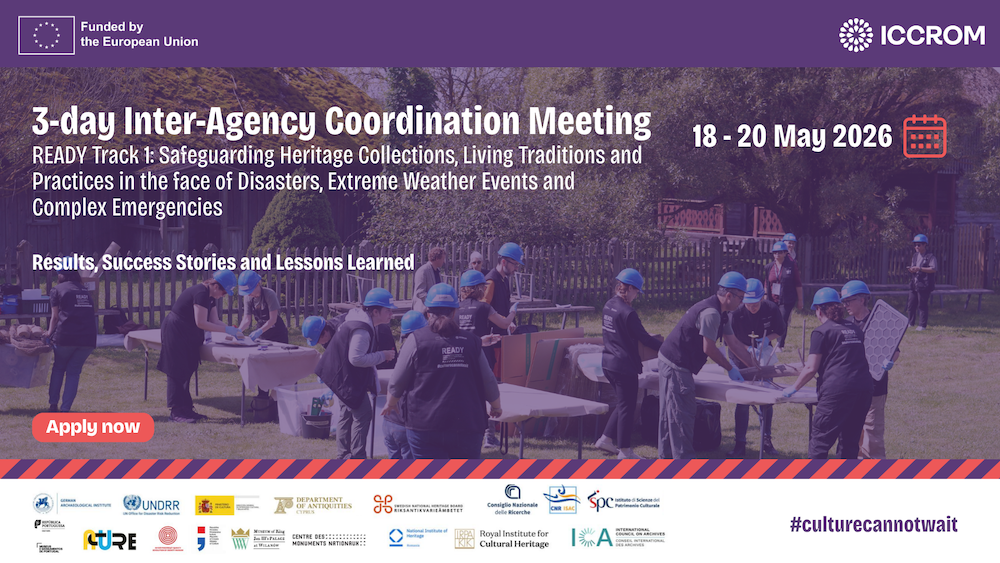
Results, Success Stories and Lessons Learned
Call for Registrations Now Open
Safeguarding Heritage Collections, Living Traditions, and Practices in the Face of Disasters, Extreme Weather Events, and Complex Emergencies
18–20 May 2026 | Online
Across Europe, a new generation of risk managers and cultural first aiders trained through ICCROM’s READY Track 1 is rethinking how to safeguard heritage collections, living traditions and cultural practices in the face of disasters, extreme weather events, and complex emergencies – and how this, in turn, strengthens community resilience.
What has emerged from their journey? What have they discovered, tested, and learned? What insights have surfaced, and what challenges have they encountered along the way?
READY – Resilience for Heritage in the Face of Disasters, Climate Risks and Complex Emergencies – led by ICCROM and supported by the European Union under the Creative Europe Programme, invites you to the first online inter-agency coordination meeting of READY Track 1.
The event will bring together practitioners, partners, and stakeholders to reflect on experiences, insights, and challenges in safeguarding heritage in risk and crisis contexts.
In line with ICCROM’s vision of conserving, activating and recognizing heritage as a tool for good, the meeting will explore how the work of READY contributes to stronger, more resilient communities and more sustainable futures.
A Network of Practice Across Europe: from Capacity Development to On-The-Ground Action
We are living in an era of polycrisis, where disasters, extreme weather events, and conflicts increasingly occur simultaneously and overlap, compounding and amplifying their impacts across systems and societies. As these risks become more frequent, intense, and interconnected, the need to strengthen capacities to safeguard cultural heritage is more urgent than ever.
READY Track 1 has brought together 24 professionals from 19 countries – across museums, archives, libraries, communities, civil protection, emergency response, heritage conservation, and the humanitarian sector. Together, they share a common focus on safeguarding collections, living traditions, and associated knowledge systems.
Using a blended learning approach – combining immersive online sessions and intensive in-person training in Riga, Latvia – READY Track 1 has enabled participants to strengthen and apply existing tools, knowledge, and good practices within a coherent framework, translating learning into action through mentored, field-based projects that test context-specific solutions.
Across Europe, participants have:
- Conducted multi-hazard risk assessments for movable and intangible heritage
- Developed and operationalized preparedness and response plans
- Implemented targeted risk mitigation measures
- Strengthened local capacities through cascading training and knowledge transfer
- Raised cross-sector awareness and advanced the integration of heritage into planning and policy
Key Takeaways from READY Track 1
The one-year implementation of READY Track 1 has highlighted several key insights:
- Awareness of risks affecting heritage is growing, but risk assessment methods and tools remain dispersed and are not yet efficiently integrated or consistently applied across institutions.
- There is still a lack of clear benchmarks and readiness indicators, particularly for intangible cultural heritage.
- Stronger indicators are needed to assess institutional preparedness for large-scale or complex emergencies and to support early recovery.
- Risk management and emergency preparedness remain insufficiently integrated into institutional policies, planning processes, and operational systems.
- At the national level, approaches across archives, museums, and libraries remain fragmented, with limited coordination, exchange, and joint action.
- Emergency preparedness efforts do not yet consistently account for the wider urban, environmental, and community contexts in which heritage is situated.
Risk must be understood across interconnected spatial scales, recognizing that heritage is embedded within broader land-water systems, ecosystems, and social environments. Building on these insights, the online inter-agency coordination meeting will offer a space to reflect on these challenges, exchange practical experiences, and identify opportunities for stronger collaboration, policy integration, and cross-sector action across – while informing how READY continues to address these needs.
A Platform for Strategic Dialogue and Policy Integration for Heritage Safeguarding
Across the heritage field, many capacity development initiatives are already underway, reflecting a strong and sustained commitment to safeguarding cultural heritage. This online inter-agency coordination meeting offers a space to bring these experiences into shared conversation, connect lessons across contexts, and reflect on what happened after training and implementation – including what is applied in practice, what is adapted, what works, what remains challenging, and what generates wider impact.
Through case studies, roundtables, keynote interventions, and panel discussions, this 3-day online coordination meeting aims to:
- Disseminate strategies and good practices for disaster risk reduction, preparedness, response, and recovery
- Enable direct dialogue with stakeholders from participating countries, including representatives from heritage, civil protection, fire services, policymaking, and other related sectors
- Strengthen the integration of heritage into disaster risk management, security, and climate adaptation plans
- Highlight how heritage contributes to climate action, disaster risk reduction, and social cohesion
- Identify practical opportunities to strengthen cross-sector collaboration for heritage safeguarding
- Identify readiness indicators for managing risks related to conflict, disasters, and extreme weather events
Coordination Meeting Themes
- Strengthening capacities for comprehensive risk assessment to evaluate the impact of disasters, conflicts and extreme weather events on heritage collections, living traditions and practices
- Anticipate to Prevent: harnessing risk-informed strategies for heritage protection
- Enhancing emergency preparedness, response and first aid for tangible and intangible heritage
- Amplifying Impact: expanding collaboration within and beyond the heritage sector
For full details on the sessions and speaker information, available in the agenda
Spotlight on READY Technical Partners
Showcasing Innovation and Leadership in Heritage Protection Across Europe and Beyond
READY brings together 18 technical partners from 14 countries across eight sectors, including heritage institutions, civil protection, research bodies, and international organizations. Through this collaboration, READY builds on existing knowledge and tools across Europe, while strengthening coordination, fostering innovation, and promoting more integrated approaches to safeguarding heritage.
This online inter-agency coordination meeting provides an important opportunity for READY partners to share insights from their work, reflect on lessons learned, and highlight the value of cross-sector collaboration in addressing complex and interconnected risks.
Why Attend
- Gain practical insights from field-based projects across 19 countries
- Discover tested tools and methodologies for risk assessment, first aid to cultural heritage, and people-centred early recovery
- Connect with cross-sector experts at the intersection of heritage, risk management, and climate resilience
- Explore how READY’s model can inform similar initiatives in other contexts
- Identify opportunities for stronger cross-sector coordination and policy integration
- Join a growing community committed to placing culture at the centre of resilience and recovery
We encourage early registration and wide circulation through your networks. Register now.