
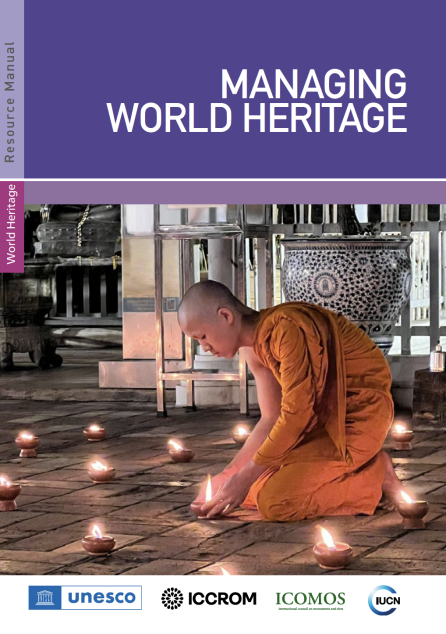
UNESCO and the Advisory Bodies to the World Heritage Committee – ICCROM, ICOMOS, and IUCN – have announced the release of a new manual, Managing World Heritage, a foundational reference document to guide conservation in World Heritage and other heritage places, outlining the key elements and processes of the management system.
World Heritage properties are facing increasingly complex challenges including development pressures, climate change, natural hazards, inadequate and insufficient maintenance and conservation. Currently, 86% of properties inscribed on the World Heritage List across 147 States Parties have experienced management issues and are supported through the Convention’s Reactive Monitoring process to address such challenges.
These trends highlight the urgent need for robust, integrated management approaches to better protect Outstanding Universal Value (OUV), link concerns for culture and nature and ensure that the rights and knowledge of Indigenous Peoples and local communities are respected in the protection and management of heritage. They also underscore the importance of equipping management institutions, site managers, and those involved in the management processes of World Heritage with the tools and resources needed to establish and strengthen management systems.
“Managing World Heritage is an ongoing and urgent challenge that requires the ‘heritage place approach’, an integrated method of management that can guide the evolution of properties over time within their dynamic social, economic and environmental contexts, enabling effective, inclusive and adaptive management,” says Lazare Eloundou Assomo, Director of World Heritage, UNESCO.
Managing World Heritage is designed as a go-to reference for site managers, rights-holders, heritage professionals, institutions, and actors involved in the management of World Heritage, by integrating and updating the existing manuals on Managing Natural World Heritage (2012) and Managing Cultural World Heritage (2013). It promotes place-based and people-centred approaches that conserve the multiple values of heritage places within their broader social, environmental and economic contexts. In doing so, it reinforces the role of heritage as a dynamic resource contributing to sustainable development and community well-being.
“The new manual highlights the importance of embracing an intersectoral participatory governance, a people-centred approach and rights-based frameworks and serves as a practical, accessible reference for capacity building and learning at all levels – from site practitioners, Indigenous Peoples and local communities to national policy-makers and regional networks” says Aruna Francesca Maria Gujral, Director-General, ICCROM.
“The new manual provides guidance for robust heritage management systems and offers insights into navigating management processes – such as management planning, implementation, monitoring and evaluation – to continuously improve our actions and achieve good results for both heritage and society,” says Teresa Patricio, President of ICOMOS International.
Importantly, the manual serves as foundational knowledge for using other tools and methodologies, including the Enhancing Our Heritage Toolkit 2.0 for assessing management effectiveness and the Guidance and Toolkit for Impact Assessments in a World Heritage Context, and international systems of best practice including the IUCN Green List Standard.
"This manual sets new objectives for heritage management, recognizing the need for integrated protection shaped by the participation of diverse sectors and connecting social, economic and environmental goals – protecting biodiversity and cultural diversity, promoting social equity and advancing sustainable development” says Dr. Grethel Aguilar, Director General, IUCN.
Developed jointly by UNESCO, ICCROM, ICOMOS and IUCN under the coordination of the ICCROM-IUCN World Heritage Leadership Programme, the manual was made possible with financial support from the Ministry of Climate and Environment of Norway.
Its content has been tested with site managers, national focal points, communities and diverse practitioners through several capacity building activities on World Heritage management including the flagship course Managing World Heritage: People, Nature, Culture as well as courses and workshops on management effectiveness, impact assessment, disaster risk management, and climate action.
The manual is available for download here
To learn more about the Managing World Heritage manual and opportunities to engage with the World Heritage Leadership programme, please contact: whl@iccrom.org